Featured post

PAM ROYDS 1924 - 2016

Pam Royds on Grasmere , 1971 with Sally Christie, children’s author and daughter of Philippa Pearce. I was just twenty two when I fir...

About Me

My photo
United Kingdom
My blog is about writing and illustrating children's books which I have been doing since 1974. www.gillianmcclure.com has all my books. I also have another blog: www.paulcoltman.blogspot.com where I publish my father's poems.

Monday, 19 September 2016

TWINS, BOATS, JETTIES &TRACTORS

This summer I went with three month old twins and their sister to a Swedish island for a week. It involved a great deal of preparation and packing and it needed a ratio of 5 adults to 3 three children to get everyone safely there and back again. 
Tove Jansson's 'The Summer Book' captures the atmosphere of a similar island in the Archipelago Sea but there are no baby twins on that island,  just one little girl and her grandmother. 


Tuesday, 9 August 2016

Thursday, 2 June 2016

PAM ROYDS 1924 - 2016

Pam Royds on Grasmere, 1971 with Sally Christie, children’s author and daughter of Philippa Pearce.

I was just twenty two when I first met Pam Royds, a year after this photo was taken. Pam was the children’s book editor at Andre Deutsch and she was working with me on my first picture book, The Emperor’s Singing Bird. Not having known any editor other than Pam, I took for granted the two decades that I enjoyed her kind and intelligent guidance, believing all editors to be like her – nurturing and patient; allowing an author/illustrator to make mistakes and develop. 
   I accepted as normal, back in 1972, the invitation to come to her house for a bath and breakfast when I stepped off the overnight bus from Edinburgh for our very first editorial meeting at the Deutsch office in Great Russell Street. I didn’t argue, when my first child was born and Pam wouldn’t allow me to take part in the wonderful Book Train event, saying I should be at home feeding the baby. And at the various awards ceremonies, over subsequent years, Pam was always by my side, giving advice on  how to lose gracefully and pointing out the authors behaving badly when they didn’t win.
    It was a sad day when Andre Deutsch sold their children’s list to Scholastic in the early 1990s but Pam made sure she was there helping her authors and illustrators make the transition. At my first meeting with my new Scholastic editor, Pam was hovering within earshot and when the meeting took a turn for the worse and the Scholastic editor said that, after all, he would not be taking me out for lunch, I remember Pam emerging forcefully from her office and saying, “Well if you won’t, I will,” and marching me off.
Oh dear, how naïve I’d been to believe all editors were like Pam; that all publishing houses were like Andre Deutsch.

And now she's gone: a beloved friend and much missed editor.


Friday, 22 April 2016

SALT ON THE PAVEMENT

My new picture book Dog on Wheels, to be published by TroikaBooks in September 2016, has a landscape of pavements – rather dull I thought, until I discovered the effect of dropping rock salt crystals into very wet watercolour washes. At first there appears to be nothing happening. However, if you leave the wash to dry naturally and then leave the salt to do its work over many hours, the big salt crystals dissolve into much smaller crystals, picking up pigment and giving a sparkly, grainy, stippled effect – just right for pavements.
  It wasn’t without its problems, though. I now had a strongly textured background which was causing a messy outline when I came to paint the foreground objects. So to avoid this and keep a clean edge, I masked all outlines before the salt wash.
I also discovered it was difficult to apply further washes over the texture without lifting it, so I put the pigment on very dry and then it would adhere and colour the crystal stipple.
    The more I worked on this book, the more I discovered about pavements. Walking slowly and looking down at them as if from a dog’s or a very small child’s viewpoint, I suddenly started to see all the amazing drain cover patterns; circles, triangles and rectangles with elaborate geometric  designs.

And as well as all these patterns there was all the information in the form of lines, arrows, signs and even shadows. Suddenly pavements were not dull at all!


Friday, 11 March 2016

LANGUAGE IS POWER


Going through the list of School Library Services in the UK can be a heart rending process as so many of them no longer exist. However, there is one county defying all the cuts and austerity – Norfolk. This very rural county has a dynamic School Library Service and, living in Cambridge where there is no longer one, I was happy to be put onto the Norfolk list of authors who go into schools and have them organise both bookings and payment, just like the good old days when the Eastern Arts Association offered this service.
  On 10 March I attended a Norfolk SLS ‘Language is Power’ conference in Norwich where the audience of primary school teachers, school librarians and authors were challenged and inspired. Key note speaker, Tanya Landman, 2015 Carnegie Winner, (Buffalo Soldier)set the tone for the day when she described the appalling library cuts in this country as the equivalent to the burning of books by unsavoury regimes.
And, Martin Illingsworth, author of Creative Approaches toTeaching Grammar, did not let his audience sit back complacently either, but shook everyone out of their comfort zone with his approach to teaching grammar. Education Secretary,Michael Gove would have squirmed in his seat or left after these two sessions.
But it was the three pupils from Litcham School, the 2014 Kids Lit Quiz champions and their presentation that really showed the impact a forward-thinking School Library Service with a belief in the power of language can have on rural state schools.

Monday, 18 January 2016

TROIKA BOOKS

Exciting news, the latest edition of Selkie has been published by Troika Books. 

This will be followed by my next picture book to be published in 2017. I’m busy working on the colour artwork but won’t say what it’s about as I want it to be a surprise. It does have dogs in it.

Sunday, 20 December 2015

HAPPY CHRISTMAS

From Mario's Angels 2006

Wishing friends and colleagues and all children's book lovers a very happy Christmas.

Thursday, 26 November 2015

NOVEMBER DIARY

3 November
The CWIG AGM followed by a talk on Non Fiction. I remember the very first time I went to one of these meetings at Drayton Gardens, back in the late nineteen eighties. Clive King was on the committee and was looking after the new members. I felt very over-awed at meeting the author of Stig of the Dump. Tonight Caroline Royds of Walker Books, daughter of my first editor, Pam Royds, was one of the speakers talking about the high production trade non fiction books that are being marketed to schools.
A First Book of Nature written by Nicola Davies and illustrated by Mark Hearld was an example held up.
Before the meeting I’d visited the House of Illustration which is conveniently close to Kings Cross station. The illustrator whose work I’d wanted to see, Laura Carlin, wasn’t showing but I saw the EH Shepard’s wartime cartoons and Lauren Child’s Dolls House.
4 November
I had to give a WI talk on Christmas books; Mario’s Angels and The Christmas Donkey . WI audiences are always appreciative and I can sell books after my talk.


10 November
This evening there was a social of the local SCBWI group in the Norfolk Café. An opportunity to meet local authors and illustrators.
13 November
A school visit with a water theme. Today it was a big junior school in Norfolk and quite a challenge to keep the attention of a year group of over eighty pupils in a school hall. I have several books with a water theme but this school wanted Selkie. I suppose because the Norfolk coast and seals are nearby. I did workshops where the pupils used puppets to help create their own watery seal story.
 14 November
Today I did a Waterstones signing in Bury St Edmunds. I had a display of artwork for customers to look at which works well and I sold 27 of my picture books.
18 November
 A visit to an Infant school. I was able to do four different workshops for the different age groups with a signing at the end of the day.
20 November
Another school visit - my last this autumn. It was another junior school linked to the one I’d visited on 13 November but not so large. This one also wanted a water theme, so I repeated my Selkie workshops and it was all a bit easier today as the numbers were more manageable.
22 November
The SCBWI Winchester conference.


I took part in a two hour panel,‘Top Tips for Self Publishing’ alongside Larisa Villar Hauser and Sarah Towle. I’d met Sarah at the 2014 Booksellers conference when she’d told me about her crowd- funded Time Traveler Tours. I always enjoy taking part in this conference as there’s such a friendly atmosphere. 


23 November
A party at the House of Commons to celebrate the 10 year Anniversary of Seven Stories, the wonderful children's book centre in Newcastle.


I traveled there with Sally Christie, Helen Craig and Adele Geras who had all donated work to the Seven Stories archive. We arrived early and were shown to the Jubilee Room which was quite small. There was time to leave our coats and bags and go into the Strangers Gallery of the House of Lords and watch a bit of the EU debate. 


At the party we were all given a copy of Drawn from theArchive. Hidden Histories of Illustration by Sarah Lawrence. Helen and I both had work we’d donated featured in the book; Helen’s Angelina Ballerina illustrations and roughs and my illustrations of Tog the Ribber. Other contributors were also at the party; among them Michael Foreman, John Lawrence, Angela Barrett and Pat Hutchins.

I’ll be returning to the House of Commons next week for the ALCS All Party Writers Group winter drinks reception. But that's in December so I’ll get this November Diary posted now.

Sunday, 25 October 2015

QUIET MONTH


October has been a quiet month apart from an event in Peterborough Waterstones and the Lowestoft Library Literary Festival earlier in the month.
 Here are the authors: Ivan Bunn, Paul Heiney, Brian Scovell, myself and Tasha O’Neill.

A quiet month is great for work on a new picture book but there’s not much to be said. It’s too soon to give away too much about this book and when I’m pushing on, head down, all day and every day, at my desk, not wanting to be distracted by anything else, it means a quiet month on the blog front. November will be different. I will have the roughs of my new book done and will be out and about again; hopefully with a little more to write about.

Wednesday, 30 September 2015

FLOOD USED IN SCHOOLS


This week the UKLA Book awards announced their long list and Flood was included in the 3-7 years category.
Copies had to be sent to the twenty teacher judges.
Since its publication, I’ve used Flood a lot in schools with nursery and foundation. I bring along original artwork for the children to look at and spot how many little creatures, besides the three main characters, are afloat on debris in the flood.


I also have colouring sheets where each creature can be matched with the object it is sitting on in the book. 

With slightly older children, we make up new characters and start a group story about a flood. Here they are insect characters to fit in with the class’ bug theme.


Then there's an opportunity to act out with puppets the orientation part of the story: ‘to the right and to the left’ when the ox, fox and hen cling on to each other’s tails and steer their way through the water.


    We end with a discussion about friendship. The characters at the start of the story are not nice to each other; the ox wants to kick the fox and the fox wants eat the hen. But they all have to cooperate and work as a team if they are going to survive the flood. By the end a change has occurred and they have become friends.

‘…they had to squash up close. Then the rain stopped and Old Slodger the Ox thought “Maybe, after all I won’t kick the fox.” And the Hungry Fox thought, “Maybe, after all, I won’t eat the hen. And Fussy Hen stopped squawking, and stopped looking this way and that, and was peaceful and quiet.’


But the big question is - will they remain friends once the flood draws back and there are fields again - when life returns to normal?


Thursday, 3 September 2015

HEFFERS EVENT


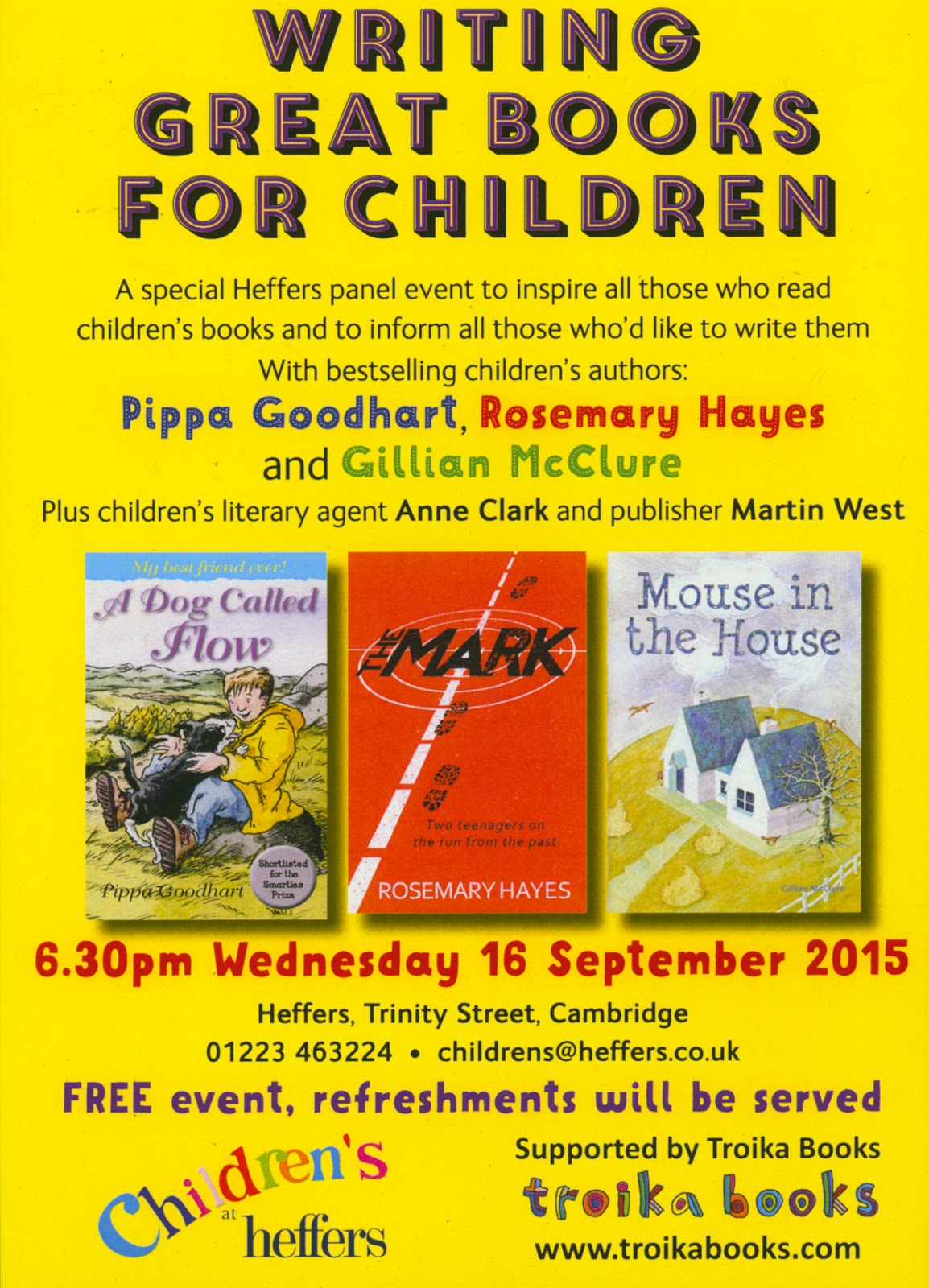
 On 16 September, at Heffers Bookshop Cambridge, a panel of three authors, a publisher and an agent will be talking about writing for children.
I’m one of the authors along with Pippa Goodhart and Rosemary Hayes. We each have a new book out. The three books fall into three different age categories:    

Rosemary Hayes’s The Mark is a young adult novel. It is edgy and fast moving; a story about a girl Rachel who is rescued from a sex gang by a mysterious boy, Jack. Realism is combined with fantasy in a masterly way. While on one level the book deals with topics relevant to today’s teenagers - the grooming of young girls, traffickers, homelessness and kids on the run - on another level it explores deeper matters. Only very gradually does the reader start to sense something uncanny underlying the developing friendship between Rachel and Jack. Rachel is Jack’s ‘mark’; despite her failings, she has a talent and is worth saving but all is not what it appears with Jack and a startling bittersweet revelation occurs at the end. Rosemary Hayes spins a great story. She structures it in such a way that the past lives of the two protagonists are told in a series of flashbacks that follow each chapter, leaving the narrative free to move at a wonderfully fast pace.

Pippa Goodhart’s A Dog Called Flow, is a chapter book for 8-12 year olds with black and white illustrations by Anthony Lewis. Although this story deals with a child’s dyslexia – Oliver is laughed at and bullied by the other children because of his learning difficulties at school– it was not written as an issue book. Instead it’s a very moving story with a gripping adventure set in a very convincing landscape. I discovered that the places that form the backdrop to the story - the waterfall, the dog show and the farm - all exist. They are in EskdaleCumbria where Pippa Goodhart’s family have a house.  
  The story starts with Oliver longing for a dog that will ‘love him loyally and uncritically.’ Against his parent’s wishes, Oliver gets a puppy which he saves from being put down. He names it Flow. Flow is blind in one eye and deaf in one ear and his disabilities and the troubles they cause subtly echo those of Oliver.
  A Dog Called Flow was Pippa’s first book; runner up in the 2004 Katherine Fidler Award and short listed for the 2005 Smarties award . It is now reissued by Troika Books.
   
My own book, Mouse in the House, is at the younger end of the picture book category. Here’s a review of it by Catriona Nicholson: 

From the front cover bird’s-eye view of a wooden house on a hill and its four local inhabitants (hawk, squirrel, cat and dog) we are held in a spell of page turns as this gentle bedtime story moves us through exquisitely illustrated spreads towards the final image of a sleeping baby, arm cradling a cloth mouse. And throughout the pages, in question and answer format, the text speaks of a mystery: who has heard, seen, smelled, touched that, as yet unseen, mouse that lives in the house on this hill? Each of the creatures, in turn and through rhyme, claims some sensual knowledge until, at last, the revelation page shows us the ‘soft, toy mouse with a squeak in its tail’. The visual journey takes us from the lofty heights of the hawk, downwards through the squirrel’s tree, into the dog’s garden, past the cat at the threshold until we are alongside the baby.  An accomplished ability to orchestrate this delicate play of rhyme, rhythm, perspective, pattern, shape, colour and light defines this picture book for the very young that offers delight at each re-reading. 

Thursday, 30 July 2015

SNIFFING

'I smell the mouse with my wet, black nose.'

With each new book, I try and do an accompanying workshop. I thought the theme of the workshop based on ‘Mouse in the House’ could be the senses; sight, hearing, smell and touch.
I had a chance of airing this new book and the new workshop too at the Wisbech Reads Festival.
    Parents with their toddlers in push chairs arrived at the gazebo in the middle of Orchard School Primary School playing field where I had a display of artwork and some props as part of an event promoting family learning. First I read the story and we looked at the pictures. Then came an activity linked to the senses.
    'Touching' was the easiest. Babies all seem to have grown up with touchy, feely books and the babies at my workshop solemnly fingered the different textures I had brought with me. ‘Seeing’ was a little trickier but we were able to play a modified game of ‘I spy’ without using any letters. ‘I spy my Mum’s eye, my Dad’s nose, etc.’ ‘Hearing’ was fun; I had all kinds of things that made noises in my bag. The tots were looking quite alert by now. But 'smell' and sniffing things, was problematic. This sense, like taste, has the potential to disgust or even bring on the sneezes. So I asked the parents to have a sniff of the scents first. In my little sealed jars I had some chocolate powder, a cinnamon stick, mint leaves and a lily flower. The parents decided whether their child would like a particular smell and the sniffling passed without mishap and my workshop ended without tears…until... a great gust of wind hit the gazebo, knocking over the flip chart, scattering pens and pencils and blowing away my artwork. 

Sunday, 5 July 2015

MOUSE IN THE HOUSE


I dedicated Mouse in the House to Connor, who is eighteen months old and can point to his eyes, ears, nose and fingers. His cousin, Liv, is two years old and starting to link her eyes to ‘seeing,’ her ears to ‘hearing,’ her nose to smelling and her fingers to touching. 'Mouse in the House' is the new Plaister Press book and is aimed at the very young child beginning to become aware of the senses. 
 Is there a mouse living in this house? Well, the bird has seen it,
 the squirrel has heard it,
 the dog has smelled it and the cat has even touched it. But this is no ordinary mouse…

This is a simple, question and answer mystery story that I chose to write in the style of a nursery rhyme with the rhyme running over the page turn. I matched this two page rhythm with a parallel rhythm in the pictures. Each animal is first seen on a double spread, followed by a close–up after the page turn where the rhyme falls; like a camera zooming in, on the eye, ear, nose and paw (in the case of the cat.)
It took me a long time to arrive at a style of illustration to match this story. Reading to both Connor and Liv, I realized that they didn’t need flat primary colours to be able to read pictures. So in the end, I settled for large painterly double page spreads in water colour with a scratched texture and simple bold patterns. The technique I used for this was to put down a dark ground colour first, then coat it in white gouache which I scratched with a pen nib at the point of drying. I'd recently seen an exhibition of Winifred and Ben Nicholson's paintings at Kettles Yard and was influenced by their scratchy look.

Sunday, 14 June 2015

2015 SOUTH SHOUT FESTIVAL


I took part in the South Shout Festival, again, working over three days with children from South London schools.

At the start, the  first ideas were all very much linked to the children’s environment – Tesco’s kept cropping up; their leisure pursuits – horror movies, video games and a lot of knives and murder; and how they were feeling – hungry – chicken and burgers featured large. And then the fire alarm went off; we’d all been told no practice alarms were scheduled for the day so if the fire alarm went off it was for real. Everyone up ended up in the street and although we weren’t meant to take anything with us, all the packed lunches came too. One boy told me he was so afraid when he heard the alarm, his heart started beating hard and fast – later he got that sensation into the climax of his story. Perhaps every creative writing class needs a fire alarm to go off.


When we all reconvened after lunch and it was my turn to nudge ideas along through a bit of drawing, I was relieved to see we were moving beyond Tesco’s,


to other settings,
where the chickens came alive


and horror was pinned down creatively in images and, later, words.


At the end of the three days, the children said that what they liked best about the South Shout Festival was the way the authors and illustrators, who had all volunteered their time, listened to their stories individually.