Featured post

PAM ROYDS 1924 - 2016

Pam Royds on Grasmere , 1971 with Sally Christie, children’s author and daughter of Philippa Pearce. I was just twenty two when I fir...

About Me

My photo
United Kingdom
My blog is about writing and illustrating children's books which I have been doing since 1974. www.gillianmcclure.com has all my books. I also have another blog: www.paulcoltman.blogspot.com where I publish my father's poems.
Showing posts with label Pippa Goodhart. Show all posts

Thursday, 3 September 2015

HEFFERS EVENT


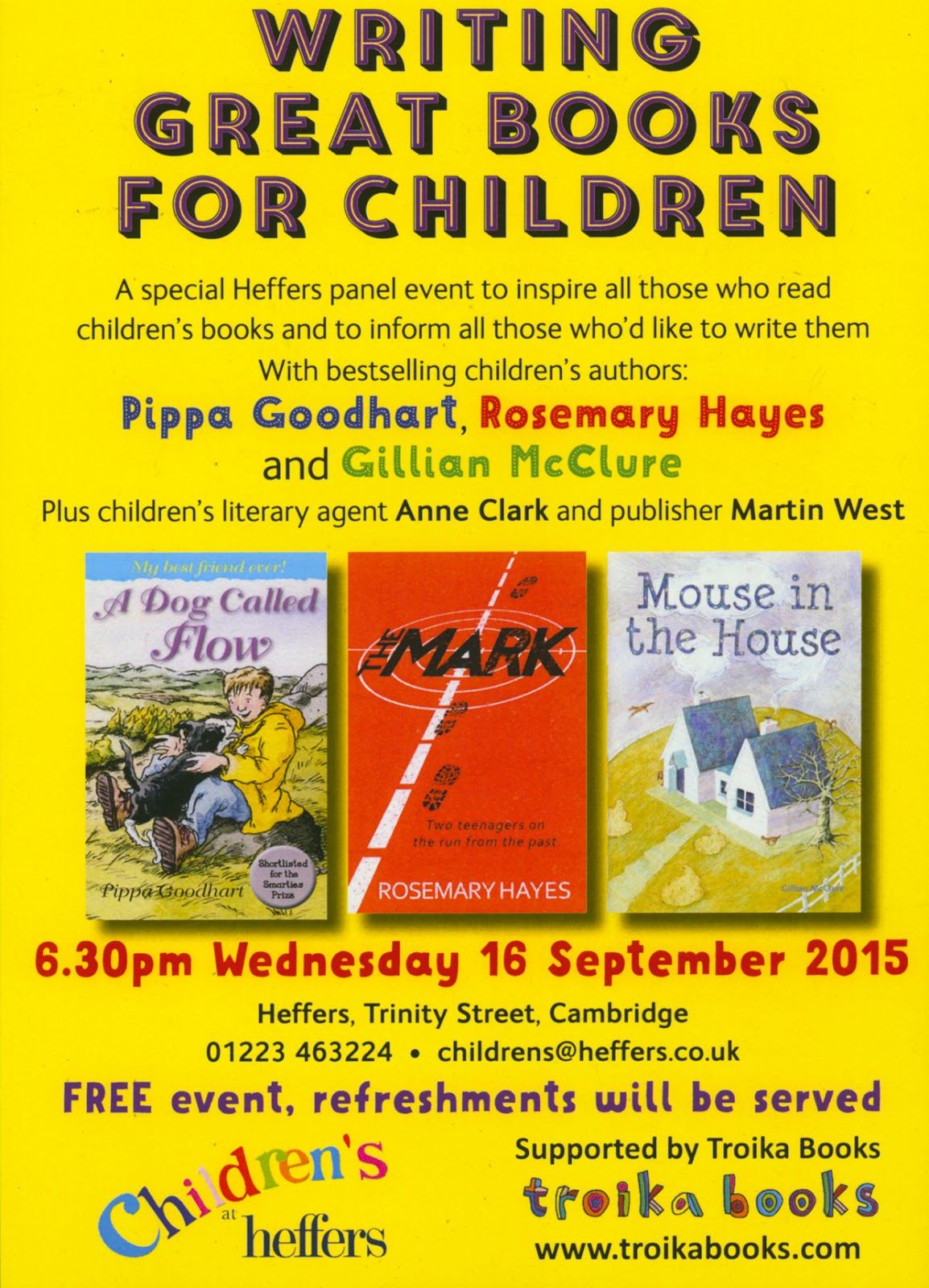
 On 16 September, at Heffers Bookshop Cambridge, a panel of three authors, a publisher and an agent will be talking about writing for children.
I’m one of the authors along with Pippa Goodhart and Rosemary Hayes. We each have a new book out. The three books fall into three different age categories:    

Rosemary Hayes’s The Mark is a young adult novel. It is edgy and fast moving; a story about a girl Rachel who is rescued from a sex gang by a mysterious boy, Jack. Realism is combined with fantasy in a masterly way. While on one level the book deals with topics relevant to today’s teenagers - the grooming of young girls, traffickers, homelessness and kids on the run - on another level it explores deeper matters. Only very gradually does the reader start to sense something uncanny underlying the developing friendship between Rachel and Jack. Rachel is Jack’s ‘mark’; despite her failings, she has a talent and is worth saving but all is not what it appears with Jack and a startling bittersweet revelation occurs at the end. Rosemary Hayes spins a great story. She structures it in such a way that the past lives of the two protagonists are told in a series of flashbacks that follow each chapter, leaving the narrative free to move at a wonderfully fast pace.

Pippa Goodhart’s A Dog Called Flow, is a chapter book for 8-12 year olds with black and white illustrations by Anthony Lewis. Although this story deals with a child’s dyslexia – Oliver is laughed at and bullied by the other children because of his learning difficulties at school– it was not written as an issue book. Instead it’s a very moving story with a gripping adventure set in a very convincing landscape. I discovered that the places that form the backdrop to the story - the waterfall, the dog show and the farm - all exist. They are in Eskdale, Cumbria where Pippa Goodhart’s family have a house.  
  The story starts with Oliver longing for a dog that will ‘love him loyally and uncritically.’ Against his parent’s wishes, Oliver gets a puppy which he saves from being put down. He names it Flow. Flow is blind in one eye and deaf in one ear and his disabilities and the troubles they cause subtly echo those of Oliver.
  A Dog Called Flow was Pippa’s first book; runner up in the 2004 Katherine Fidler Award and short listed for the 2005 Smarties award . It is now reissued by Troika Books.
   
My own book, Mouse in the House, is at the younger end of the picture book category. Here’s a review of it by Catriona Nicholson: 

From the front cover bird’s-eye view of a wooden house on a hill and its four local inhabitants (hawk, squirrel, cat and dog) we are held in a spell of page turns as this gentle bedtime story moves us through exquisitely illustrated spreads towards the final image of a sleeping baby, arm cradling a cloth mouse. And throughout the pages, in question and answer format, the text speaks of a mystery: who has heard, seen, smelled, touched that, as yet unseen, mouse that lives in the house on this hill? Each of the creatures, in turn and through rhyme, claims some sensual knowledge until, at last, the revelation page shows us the ‘soft, toy mouse with a squeak in its tail’. The visual journey takes us from the lofty heights of the hawk, downwards through the squirrel’s tree, into the dog’s garden, past the cat at the threshold until we are alongside the baby.  An accomplished ability to orchestrate this delicate play of rhyme, rhythm, perspective, pattern, shape, colour and light defines this picture book for the very young that offers delight at each re-reading. 

Sunday, 28 October 2012

IN CONVERSATION WITH PIPPA GOODHART


In this post I’m in conversation with children’s author, Pippa Goodhart, pictured above. She invited me to a lovely lunch at her house a couple of weeks ago and it was at that lunch that I met her dog.
Gillian McClure: I was very taken with your dog Winnie now renamed ‘Winnie the Trifle Licker’ after her small indiscretion at your lunch party the other week.  But where does the name Winnie come from? Though  I think I can guess.
Pippa Goodhart:  My husband, three daughters and I went to Manchester to see eight puppies, all of them wonderful fat wriggly half-collie half-spaniels.  After much agonising, we chose the one that they were calling Splash, because of the shape of the marking across her face.  My youngest daughter suggested on the journey home that we might call her Winnie instead; Winnie the female-canine, named after the Winnie the Witch.  I’d just started working on Winnie the Witch stories and Winnie stories paid for her. 


Gillian: Well that explains all her doggy mischief. I’d love to know how you came to write the stories about Winnie the Witch and why you write them under a pseudonym.

Pippa: Australian author Valerie Thomas wrote the first, very simple and clever, story twenty-five years ago. Korky Paul illustrated it in his brilliantly mad, energetic, funny and inventive style, and Winnie the Witch came to picture book life. In the quarter century since then, a number of other Winnie picture books have come out. But, about four years ago, OUP decided that they wanted some longer story books about Winnie, aimed at a slightly older age group. There would be four stories in a book, illustrated in black and white. Valerie Thomas didn’t want to write them, but she agreed that I could write the stories so long as the invented name of Laura Owen was used on all the book covers.
Gillian: Was Laura Owen your name or Valerie’s?

Pippa: The choice of ‘Laura Owen’ was entirely Valerie’s. I suggested just putting Korky’s name on the cover, and leaving the author out altogether but she insisted on the Laura name.
I’ve written sixty-four stories about Winnie and her cat Wilbur … and in one of them there’s a clue that I’m the ghost writer of the those stories!
Gillian: I’d love to know which one.

Pippa: The story that gives a clue to me being the ghost writer is ‘Winnie And The Ghost In The Post’ (it comes in Mini Winnie). Winnie, who is no good at reading or writing, decides to use a ghost writer to help her enter a poetry competition. She sends off for a ghost, which she calls Post Ghost, or PG for short .... ie my initials. I’m sure nobody ever notices it, but it pleased me to sneak myself in there!

Gillian: Fascinating. But was it hard being a ghost writer? What sort of problems did you encounter?
Pippa: It was odd taking on a fictional character who already existed, and I wasn’t sure how that would work. So I began rather tentatively, feeling my way. But I soon realised that my stories were only going to work if I made Winnie and Wilbur my own characters. Winnie needed to be a more complex character than she is in the picture books because the stories are a lot more involved. Winnie is a strange mix of adult and child, along with the ability to do magic…but that magic must be used sparingly, or everything could be too easily solved, and you’d have no stories! Meanwhile Wilbur the cat is much cleverer than Winnie, but he can’t do magic, and he is a cat who can’t talk beyond a meow. The two of them, loving and bickering, make a fun pair to play with.
I also play with language in the Winnie stories, and that’s something that people seem to either love or hate (see the Amazon reviews!). Winnie exclaims in ways that sound dangerously as if they might be rude, but actually aren’t (“Thank knitted noodles for that!”) and she does eat some disgusting things. So, for example, having finished making a sandcastle at the seaside, Winnie says to Wilbur,
“There! That’s as pretty as a ferret in fairy wings. I reckon we’ve earned ourselves a nice lice lolly.”

Gillian: I think children love that sort of thing and also it’s good for making them think creatively about words. Finally, what about the collaboration with the illustrator Korky Paul? I’m interested to hear about that.
Pippa: As you can imagine, writing with Korky Paul illustrations in mind is a treat because he likes things the madder the better! I can leave gaps that I know that he will enjoy filling. I can put something like, ‘For breakfast Winnie had one of these … some of those…and a few of them’, and Korky will invent the most wonderful things on plates and in packets and creeping out of pockets!

Gillian: I bet Korky would have done a really funny drawing of Winnie licking the trifle.


Saturday, 13 October 2012

LITERARY LUNCH

What could be nicer than a literary lunch on a glorious October day at a beautiful location in Grantchester: 
 … “would I were
In Grantchester, in Grantchester!”
-except for an unseen menace, 
“[ in] the lovely hamlet Grantchester”.  
- a dog who smelt a pudding in a bag and got to it before being spotted. 
 
Here are Adele Geras, Anne Roony and Pippa Goodhart inspecting lick marks on the pudding.

 
Here they are again deciding the unlicked parts could still be eaten...

And so, with the dog (whose name was Winnie,) banished out of earshot, out of sight, lunch was restored.
“… Grantchester! Ah Grantchester!
There’s peace and holy quiet there…”

 and

“Stands the Church clock at ten to three?
And is there honey still for tea?”

 
Quotes from 'The Old Vicarage, Grantchester' by Rupert Brooke 1912