Featured post

PAM ROYDS 1924 - 2016

Pam Royds on Grasmere , 1971 with Sally Christie, children’s author and daughter of Philippa Pearce. I was just twenty two when I fir...

About Me

My photo
United Kingdom
My blog is about writing and illustrating children's books which I have been doing since 1974. www.gillianmcclure.com has all my books. I also have another blog: www.paulcoltman.blogspot.com where I publish my father's poems.
Showing posts with label Philippa Pearce. Show all posts

Friday, 12 July 2013

HELEN CRAIG'S HORSES

Helen Craig, granddaughter of the theatrical designer, Edward Gordon Craig, is best known as the illustrator of Angelina Ballerina, written by Katharine Holabird. However, there are many other facets to Helen’s art and it is not just mice that she likes to draw.  As well as being an illustrator, Helen is a sculptor and print maker and she has a fascination for horses too, despite being petrified by them.
I spotted this little horse on her mantle piece when I visited her a couple of weeks ago.  
It was the horse that inspired these images in Amy's Three Best Things; a story written by Philippa Pearce (1920 –2006).  


Helen told me she was delighted when she was offered a chance to re-illustrate Amy's Three Best Things. And it was the little horse on the mantelpiece that helped bring about that strange metamorphosis illustrators can have when an object leads you into a story.
Suddenly, I spotted other horses that Helen had made out of clay -
 
– there was even one lurking in the flower borders of her garden.  
She showed some of her horse etchings – hauntingly surreal and very different from her Angelina Ballerina images.
I was beginning to understand now why it was a horse that was the catalyst for the images in Amy’s Three Best Things.  In the story, Amy brings her three best things with her when she goes to visit her Granny: a bedside mat, a little horse and a toy boat. At night, when she starts to miss her mother, Amy finds each of these things can take her back to her own home where she catches a glimpse of her family before returning, comforted, to her Granny’s house.
    I love seeing roughs so we went up to Helen’s studio where she showed me how she created the illustrations for this delightful book working with her son, Ben Norland, Art  Director at Walker Books. Here is the process from thumb nail sketch through to final illustration:
the thumbnail sketches,
the first layout with text,
the first rough in ink when the layout changed to a double page spread,
 
the first colour rough, photocopied and colour tested,
the final pencil drawing where the houses have been moved clear of the horse's hooves: half size (145mm height by 372mm width)
and the final piece of artwork which the publisher then enlarged to 215mm height by 530mm width.
By working with photocopied pencil drawings, Helen was able to achieve a lithographic effect which adds to the spontaneity and magic of these illustrations.

Copyright @ Helen Craig

Wednesday, 25 January 2012

ARTISTS' STUDIOS


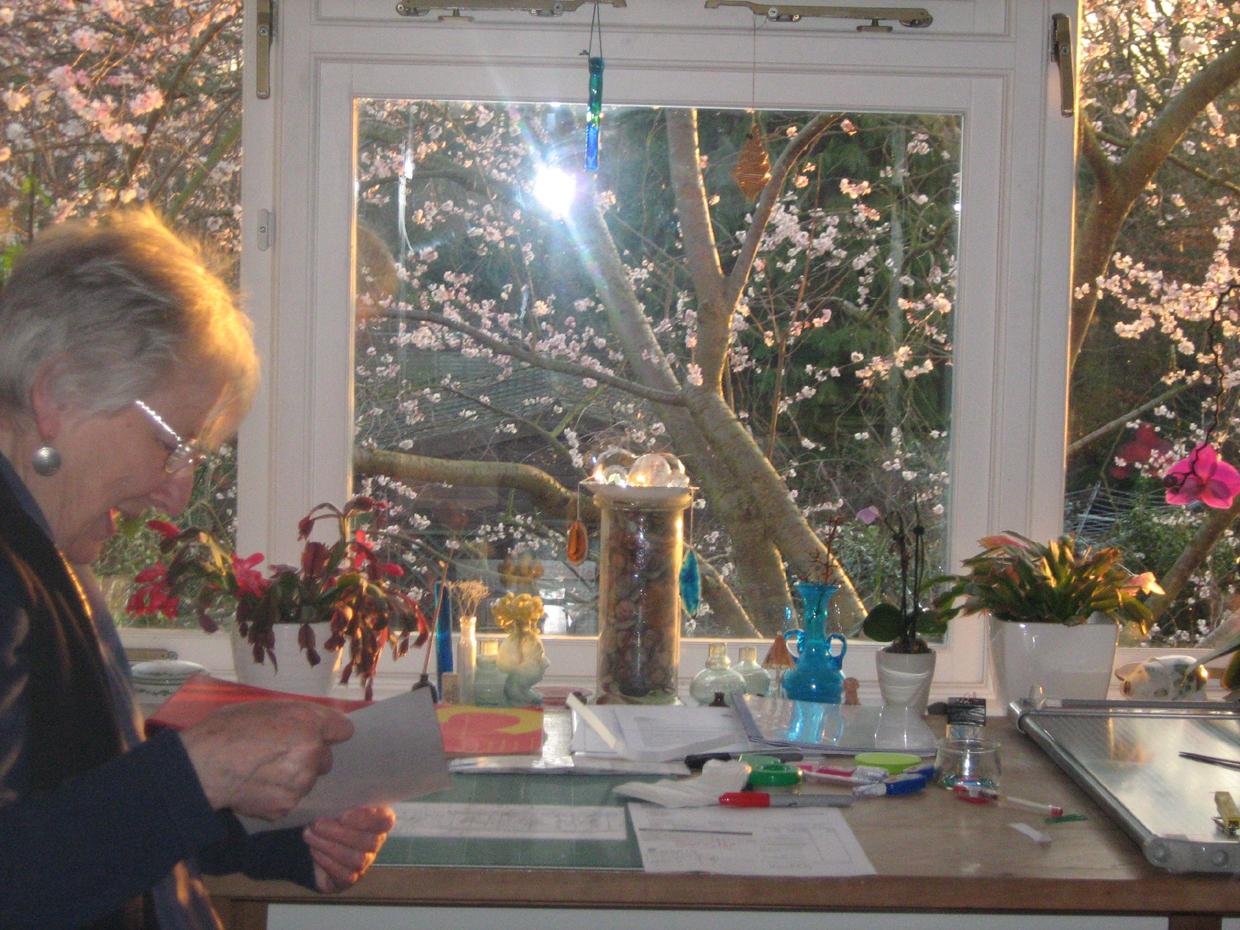
Here is Helen Craig in her studio with a prunus subhirtella autumnalis blooming mid-winter just outside her window. Wonderful to work up among the branches of a tree along with the birds.
    Helen has illustrated many books besides Katherine Holabird's Angelina Ballerina stories. She's currently working on a posthumous picture book story by Philippa Pearce for Walker Books, Amy's Three Best Things which is coming out next year.  


She signed this box set of This is the Bear that she did with Sarah Hayes - perfect for my two very young grandsons, as the stories all have the nursery rhythm of This is the House that Jack Built and Helen's gentle, humorous pictures are just right for that age.

Sunday, 3 July 2011

KIDSBOOKS

I've just returned from Vancouver.
While there, I visited an independent children's bookshop, Kidsbooks and met the bookseller, Phyllis Simon. What struck me first about her shop was its size and then after a long browse its huge range of books.    
    "Business thrives," Phyllis told me, " because parents in Vancouver are very concerned about their children's literacy and they support the bookshop".
     Phyllis, who has a library background, is an Anglophile and is enthusiastic about our children's literary tradition. She wanted to talk about Philippa Pearce and Minnow on the Say, Lucy Boston and the Green Knowe stories, Anne Fine and Helen Oxenbury. However, there was a note of disappointment when she described the range of books she saw in a large London bookshop when she was recently in the UK. Whereas the best of the UK's children's books get into bookshops in Canada and the US she didn't see it happening so much the other way round and, as a result, thought the UK was missing a lot of good books originating in North America. 

Thursday, 20 May 2010

THE PEARCE MEMORIAL LECTURE


I always associate hens with Philippa Pearce - she loved to keep hens and we did a book together in 1996 - The Little White Hen.


Philippa died in 2006 and the Pearce Memorial Lecture was set up in recognition of her great contribution to children's literature. Last year Michael Rosen was the guest speaker at Homerton College, Cambridge and today the steering committee met to plan the 2010 lecture which will be held at the Seven Stories Children's Book Centre in Newcastle with Michael Morpurgo the speaker. Next year the lecture will be back in Cambridge again and Philip Pullman will be the speaker. Follow the link to find out more about the lectures and how to book: http://www.pearcelecture.com/

Sunday, 24 January 2010

GRANNY'S CLOCKS


In  Tom's Midnight Garden by Philippa Pearce there's a grandfather clock that strikes thirteen in the middle of the night. Tom discovers time does strange things at that hour.
Below is Philippa's own grandfather clock decorated by Anthony Maitland with images from her book:


On my kitchen wall there are three clocks. It feels as if time is moving about when I look at them -but in a more mundane way. There will be many grannies with families overseas who have clocks like mine, helping them avoid waking people up in the middle of the night.


Time present and time past
Are both perhaps present in time future,
And time future contained in time past.

T.S. Eliot: Four Quartets, Burnt Norton