Featured post

PAM ROYDS 1924 - 2016

Pam Royds on Grasmere , 1971 with Sally Christie, children’s author and daughter of Philippa Pearce. I was just twenty two when I fir...

About Me

My photo
United Kingdom
My blog is about writing and illustrating children's books which I have been doing since 1974. www.gillianmcclure.com has all my books. I also have another blog: www.paulcoltman.blogspot.com where I publish my father's poems.

Sunday, 25 October 2015

QUIET MONTH


October has been a quiet month apart from an event in Peterborough Waterstones and the Lowestoft Library Literary Festival earlier in the month.
 Here are the authors: Ivan Bunn, Paul Heiney, Brian Scovell, myself and Tasha O’Neill.

A quiet month is great for work on a new picture book but there’s not much to be said. It’s too soon to give away too much about this book and when I’m pushing on, head down, all day and every day, at my desk, not wanting to be distracted by anything else, it means a quiet month on the blog front. November will be different. I will have the roughs of my new book done and will be out and about again; hopefully with a little more to write about.

Wednesday, 30 September 2015

FLOOD USED IN SCHOOLS


This week the UKLA Book awards announced their long list and Flood was included in the 3-7 years category.
Copies had to be sent to the twenty teacher judges.
Since its publication, I’ve used Flood a lot in schools with nursery and foundation. I bring along original artwork for the children to look at and spot how many little creatures, besides the three main characters, are afloat on debris in the flood.


I also have colouring sheets where each creature can be matched with the object it is sitting on in the book. 

With slightly older children, we make up new characters and start a group story about a flood. Here they are insect characters to fit in with the class’ bug theme.


Then there's an opportunity to act out with puppets the orientation part of the story: ‘to the right and to the left’ when the ox, fox and hen cling on to each other’s tails and steer their way through the water.


    We end with a discussion about friendship. The characters at the start of the story are not nice to each other; the ox wants to kick the fox and the fox wants eat the hen. But they all have to cooperate and work as a team if they are going to survive the flood. By the end a change has occurred and they have become friends.

‘…they had to squash up close. Then the rain stopped and Old Slodger the Ox thought “Maybe, after all I won’t kick the fox.” And the Hungry Fox thought, “Maybe, after all, I won’t eat the hen. And Fussy Hen stopped squawking, and stopped looking this way and that, and was peaceful and quiet.’


But the big question is - will they remain friends once the flood draws back and there are fields again - when life returns to normal?


Thursday, 3 September 2015

HEFFERS EVENT


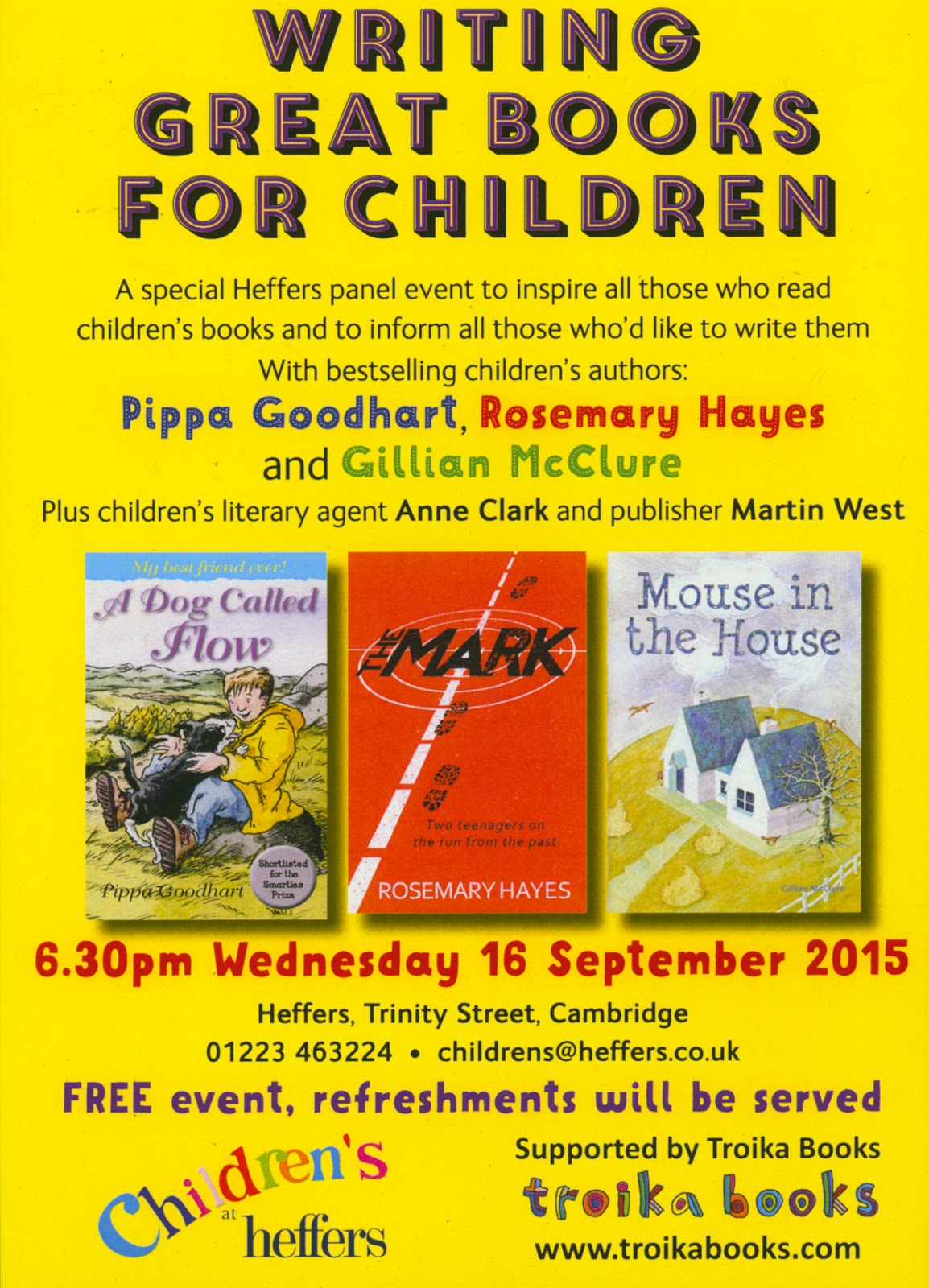
 On 16 September, at Heffers Bookshop Cambridge, a panel of three authors, a publisher and an agent will be talking about writing for children.
I’m one of the authors along with Pippa Goodhart and Rosemary Hayes. We each have a new book out. The three books fall into three different age categories:    

Rosemary Hayes’s The Mark is a young adult novel. It is edgy and fast moving; a story about a girl Rachel who is rescued from a sex gang by a mysterious boy, Jack. Realism is combined with fantasy in a masterly way. While on one level the book deals with topics relevant to today’s teenagers - the grooming of young girls, traffickers, homelessness and kids on the run - on another level it explores deeper matters. Only very gradually does the reader start to sense something uncanny underlying the developing friendship between Rachel and Jack. Rachel is Jack’s ‘mark’; despite her failings, she has a talent and is worth saving but all is not what it appears with Jack and a startling bittersweet revelation occurs at the end. Rosemary Hayes spins a great story. She structures it in such a way that the past lives of the two protagonists are told in a series of flashbacks that follow each chapter, leaving the narrative free to move at a wonderfully fast pace.

Pippa Goodhart’s A Dog Called Flow, is a chapter book for 8-12 year olds with black and white illustrations by Anthony Lewis. Although this story deals with a child’s dyslexia – Oliver is laughed at and bullied by the other children because of his learning difficulties at school– it was not written as an issue book. Instead it’s a very moving story with a gripping adventure set in a very convincing landscape. I discovered that the places that form the backdrop to the story - the waterfall, the dog show and the farm - all exist. They are in EskdaleCumbria where Pippa Goodhart’s family have a house.  
  The story starts with Oliver longing for a dog that will ‘love him loyally and uncritically.’ Against his parent’s wishes, Oliver gets a puppy which he saves from being put down. He names it Flow. Flow is blind in one eye and deaf in one ear and his disabilities and the troubles they cause subtly echo those of Oliver.
  A Dog Called Flow was Pippa’s first book; runner up in the 2004 Katherine Fidler Award and short listed for the 2005 Smarties award . It is now reissued by Troika Books.
   
My own book, Mouse in the House, is at the younger end of the picture book category. Here’s a review of it by Catriona Nicholson: 

From the front cover bird’s-eye view of a wooden house on a hill and its four local inhabitants (hawk, squirrel, cat and dog) we are held in a spell of page turns as this gentle bedtime story moves us through exquisitely illustrated spreads towards the final image of a sleeping baby, arm cradling a cloth mouse. And throughout the pages, in question and answer format, the text speaks of a mystery: who has heard, seen, smelled, touched that, as yet unseen, mouse that lives in the house on this hill? Each of the creatures, in turn and through rhyme, claims some sensual knowledge until, at last, the revelation page shows us the ‘soft, toy mouse with a squeak in its tail’. The visual journey takes us from the lofty heights of the hawk, downwards through the squirrel’s tree, into the dog’s garden, past the cat at the threshold until we are alongside the baby.  An accomplished ability to orchestrate this delicate play of rhyme, rhythm, perspective, pattern, shape, colour and light defines this picture book for the very young that offers delight at each re-reading. 

Thursday, 30 July 2015

SNIFFING

'I smell the mouse with my wet, black nose.'

With each new book, I try and do an accompanying workshop. I thought the theme of the workshop based on ‘Mouse in the House’ could be the senses; sight, hearing, smell and touch.
I had a chance of airing this new book and the new workshop too at the Wisbech Reads Festival.
    Parents with their toddlers in push chairs arrived at the gazebo in the middle of Orchard School Primary School playing field where I had a display of artwork and some props as part of an event promoting family learning. First I read the story and we looked at the pictures. Then came an activity linked to the senses.
    'Touching' was the easiest. Babies all seem to have grown up with touchy, feely books and the babies at my workshop solemnly fingered the different textures I had brought with me. ‘Seeing’ was a little trickier but we were able to play a modified game of ‘I spy’ without using any letters. ‘I spy my Mum’s eye, my Dad’s nose, etc.’ ‘Hearing’ was fun; I had all kinds of things that made noises in my bag. The tots were looking quite alert by now. But 'smell' and sniffing things, was problematic. This sense, like taste, has the potential to disgust or even bring on the sneezes. So I asked the parents to have a sniff of the scents first. In my little sealed jars I had some chocolate powder, a cinnamon stick, mint leaves and a lily flower. The parents decided whether their child would like a particular smell and the sniffling passed without mishap and my workshop ended without tears…until... a great gust of wind hit the gazebo, knocking over the flip chart, scattering pens and pencils and blowing away my artwork. 

Sunday, 5 July 2015

MOUSE IN THE HOUSE


I dedicated Mouse in the House to Connor, who is eighteen months old and can point to his eyes, ears, nose and fingers. His cousin, Liv, is two years old and starting to link her eyes to ‘seeing,’ her ears to ‘hearing,’ her nose to smelling and her fingers to touching. 'Mouse in the House' is the new Plaister Press book and is aimed at the very young child beginning to become aware of the senses. 
 Is there a mouse living in this house? Well, the bird has seen it,
 the squirrel has heard it,
 the dog has smelled it and the cat has even touched it. But this is no ordinary mouse…

This is a simple, question and answer mystery story that I chose to write in the style of a nursery rhyme with the rhyme running over the page turn. I matched this two page rhythm with a parallel rhythm in the pictures. Each animal is first seen on a double spread, followed by a close–up after the page turn where the rhyme falls; like a camera zooming in, on the eye, ear, nose and paw (in the case of the cat.)
It took me a long time to arrive at a style of illustration to match this story. Reading to both Connor and Liv, I realized that they didn’t need flat primary colours to be able to read pictures. So in the end, I settled for large painterly double page spreads in water colour with a scratched texture and simple bold patterns. The technique I used for this was to put down a dark ground colour first, then coat it in white gouache which I scratched with a pen nib at the point of drying. I'd recently seen an exhibition of Winifred and Ben Nicholson's paintings at Kettles Yard and was influenced by their scratchy look.

Sunday, 14 June 2015

2015 SOUTH SHOUT FESTIVAL


I took part in the South Shout Festival, again, working over three days with children from South London schools.

At the start, the  first ideas were all very much linked to the children’s environment – Tesco’s kept cropping up; their leisure pursuits – horror movies, video games and a lot of knives and murder; and how they were feeling – hungry – chicken and burgers featured large. And then the fire alarm went off; we’d all been told no practice alarms were scheduled for the day so if the fire alarm went off it was for real. Everyone up ended up in the street and although we weren’t meant to take anything with us, all the packed lunches came too. One boy told me he was so afraid when he heard the alarm, his heart started beating hard and fast – later he got that sensation into the climax of his story. Perhaps every creative writing class needs a fire alarm to go off.


When we all reconvened after lunch and it was my turn to nudge ideas along through a bit of drawing, I was relieved to see we were moving beyond Tesco’s,


to other settings,
where the chickens came alive


and horror was pinned down creatively in images and, later, words.


At the end of the three days, the children said that what they liked best about the South Shout Festival was the way the authors and illustrators, who had all volunteered their time, listened to their stories individually.


Wednesday, 27 May 2015

THINGS THAT CAN COMFORT

Well, mine was a lamb – his name was Baa-nim. The only bit of Baar-nim that had magical comforting powers was his tail which I rubbed against my nose. Baar-nim’s tail had to be replaced several times during my childhood and now it is gone for good.
One of my sons didn’t need a special thing; just sucked his thumb. The other two did; one had a ‘Shawly’ (originally a beautiful shawl knitted by a Scottish neighbour at his birth) and the other a ‘Bompy;’ a striped football scarf. ‘Shawly’ and ‘Bompy’ survived surreptitiously all through Primary school; were both smuggled into Cubs camp and hidden at the bottom of sleeping bags. My sons weren’t the only Cubs with comforters. Hidden in every sleeping bag in every tent was some sucked, worn, unravelling, but very precious thing, that mustn't be discovered for fear it would be mocked.
Now there’s money to be made out of comforters: little creatures designed with dangly bits to suck and stroke that regularly have to be replaced. This little girl needs at least three at night plus several more replacements in the washing machine. But her army of bunnies do the trick because with them all around her, she’s happy to go to bed and doesn’t mind the dark.  
When I drew the mouse in my new book, I decided to turn it into a thing that can comfort with a bit of cloth attached for rubbing and fingering at bedtime.